Mr Tariq Ayoub - 9 Sep 2024
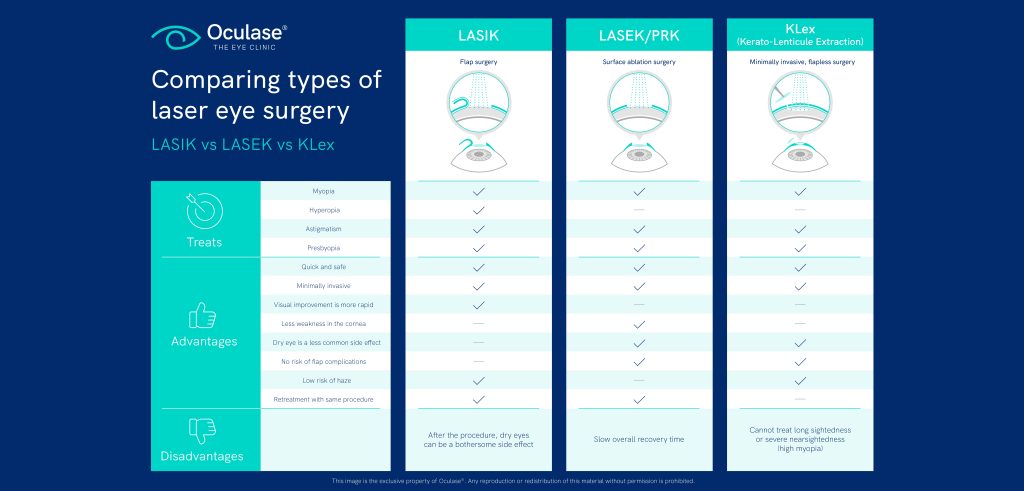
It can be difficult to decide on the right type of laser eye surgery. Your ophthalmologist will help you decide based on your health and individual needs. They will help walk you through the advantages and disadvantages of each type of procedure and determine which will suit you best based on your expected outcomes.
Some of these advantages and disadvantages are listed below.
LASIK
LASIK is the most common type of eye surgery and is relatively painless. It involves creating a flap in the cornea to allow the laser to change its shape.
Treats:
Advantages
- Quick and safe procedure
- Minimally invasive
- Visual improvement is more rapid
- Low risk of haze
- Able to have re-treatment with the same procedure
Disadvantages
Dry eyes can be a bothersome side effect
LASEK/PRK
LASEK involves using dilute alcohol to soften and roll back a thin flap of the cornea’s outer layer (epithelium) to perform the laser treatment, reshaping the cornea and correcting vision.
Trans-PRK involves removing the epithelium using a laser to access the cornea. The cornea is reshaped with the same laser to correct your vision.
Treats:
- Myopia
- Astigmatism
- Presbyopia
Advantages
- Quick and safe procedure
- Minimally invasive
- Less weakness in the cornea after the procedure
- Dry eyes are a less common side effect
- No risk of flap complications
- Able to have re-treatment with the same procedure
Disadvantages
Slow overall recovery time
KLex (Kerato-Lenticule Extraction)
Kerato-Lenticule Extraction (KLex) surgery involves making a small hole in the cornea using a (femtosecond) laser. The laser uses a series of pulses in the centre of the cornea to remove a section. When part of it is removed, the shape of the cornea changes and refractive errors are corrected.
Treats:
- Myopia
- Astigmatism
- Presbyopia
Advantages
- Quick and safe procedure
- Minimally invasive
- Dry eyes are a less common side effect
- No risk of flap complications
- Able to have re-treatment with the same procedure
- Low risk of haze
Disadvantages
Cannot treat long-sightedness or severe nearsightedness (high myopia)
At Oculase, we can help guide you through which laser eye procedure would suit you during our initial consultation. Book an appointment to talk to one of our expert specialists today.
If you want to learn more about the different types of laser eye surgery and what they involve in further detail, check out our blog, ‘Which laser eye surgery procedure is right for me?‘.