Mr Tariq Ayoub - 15 Jul 2024
Laser Eye Surgery from only £1,900 per eye
Knowing which laser eye surgery procedure is right for you can be difficult, as there are many laser surgery options to choose from. Your ophthalmologist will help you decide which procedure you should go for based on your health and individual needs.
At Oculase, we can help guide you through which laser eye procedure would suit you during our initial consultation. To prepare for your appointment beforehand, we have broken down each procedure and who might benefit.
Am I eligible for laser eye surgery?
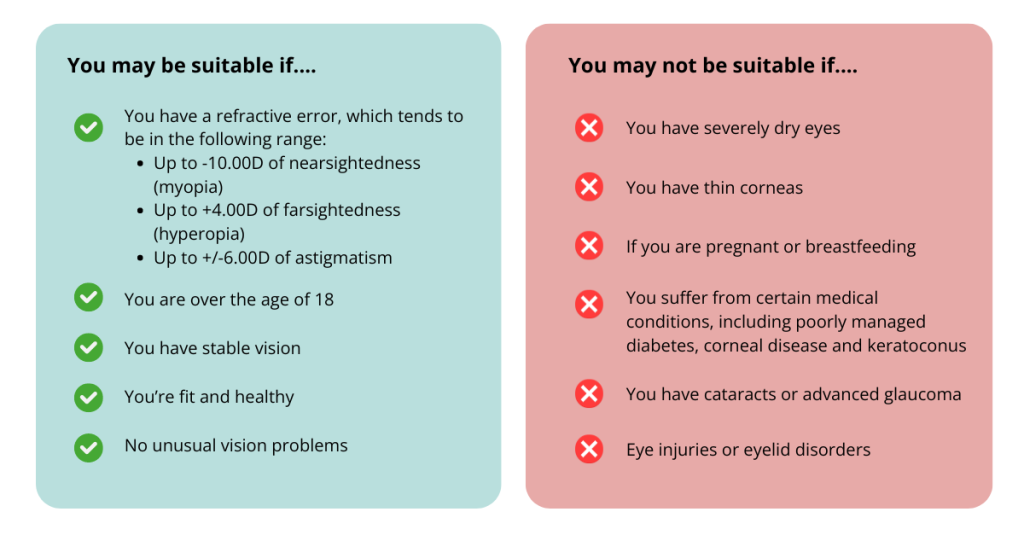
Determining if you are a suitable candidate for laser eye surgery is important. During your consultation, our ophthalmologist will evaluate your eyes thoroughly to decide whether you’re a likely candidate.
Typically, we will base our decision on some of the following factors:
LASIK
LASIK is the most common type of eye surgery and is relatively painless. It involves creating a flap in the cornea to allow the laser to change its shape.
Watch our video to learn how we perform LASIK surgery.
This procedure is best for people with common sight problems, such as myopia, hyperopia, or astigmatism.
Other benefits of LASIK include:
- Fast healing time
- Minimally invasive eye surgery
- Improves vision to 20/40 or better
- Discomfort is mild and resolves quickly
- Reduced risk of complications, such as blurred vision
This treatment is less suitable if you have a thin cornea, as it leaves less tissue if retreatment is needed.
LASEK
LASEK involves using dilute alcohol to soften and roll back a thin flap of the cornea’s outer layer (epithelium) to perform the laser treatment, reshaping the cornea and correcting vision.
It generally has a slower recovery after surgery than LASIK. However, it may be a suitable option if you have a thin cornea (as it doesn’t waste tissue) or a medical condition that can make laser eye surgery more challenging.
There is no flap cut and created in the eye, which means there is less weakness in the cornea. This means there is less chance of an injury to the eye after treatment, which may be especially useful for sportspeople where this is potentially more of a risk e.g. those who play contact sports such as wrestling.
Other benefits of LASEK include:
- Minimally invasive eye surgery
- Quick and safe surgery procedure
- Dry eye side effect is less common than LASIK
Trans-PRK
Trans-PRK involves removing the epithelium using a laser to access the cornea. The cornea is reshaped with the same laser to correct your vision. During recovery, you may need to wear a protective lens to help your eye(s) heal.
Watch our video to learn how we perform PRK surgery.
Recovery and vision stabilisation after PRK is slower than LASIK surgery. However, PRK is a good alternative to LASIK and LASEK, particularly for people with very thin corneas who would otherwise not be considered candidates for laser eye treatment.
Hear how Trans-PRK with monovision helped this Oculase patient: Patricia, Royal College, Trans-PRK with Monovision for Presbyopia.
Laser Assisted Lenticule Extraction (LALEX)
Laser Assisted Lenticule Extraction (LALEX) surgery involves making a small hole in the cornea using a (femtosecond) laser. The laser uses a series of pulses in the centre of the cornea to remove a section. When part of it is removed, the shape of the cornea changes and refractive errors are corrected.
This procedure can correct common sight problems, myopia and astigmatism.
Benefits of LALEX include:
- Fast healing time
- Minimally invasive eye surgery
- Discomfort is mild and resolves quickly
- No risk of flap complications
- The risk of dry eyes after surgery is less common
Wavefront
Most, if not all, laser eye surgeries done currently use wavefront treatment. During the procedure, data from a wavefront aberrometer (an advanced diagnostic tool) is collected to create a map of your eye, giving an accurate picture of the aberrations to be corrected. This map is used to control the laser so that it can reshape the cornea precisely to your specific requirements. This customised treatment plan gives you a superior quality of vision compared to standard conventional treatment.
Wavefront treatment is broadly divided into two types: wavefront-optimised and wavefront-guided. Both have shown similar results. However, wavefront-guided treatment tends to remove more tissue than wavefront-optimised treatment.
Wavefront treatments, in general, involve less tissue removal than conventional laser-assisted LASIK, making them safer than standard LASIK procedures. Due to wavefront optimised customised laser treatment taking less tissue away than wavefront guided treatment, it is typically used for laser treatments such as LASIK, PRK, and LALEX.
At Oculase, we only use wavefront assisted treatments for refractive vision correction laser eye surgery including LASIK and trans-PRK.
Other treatment options
If you are not eligible for any laser eye treatment, we may recommend alternative procedures to help solve your vision problems. They can include the following:
Implantable contact lenses (ICL)
Implantable contact lenses (ICL) involve inserting an additional soft, very thin lens in front of your natural lens to change your prescription. The ICL lens is not visible to the naked eye, doesn’t have to be removed or cleaned like traditional lenses, and can remain in the eye permanently.
Implantable contact lenses can be an option if your prescription is too strong for laser eye surgery, or you can’t tolerate contact lenses but want to retain the natural flexibility in your own lenses.
It is also a good option if you have stable keratoconus, thin corneas, dry eyes, and other minor corneal problems.
Lens replacement surgery
Lens replacement surgery, or Refractive Lens Exchange (RLE), involves making an incision to replace your current lens with an artificial one.
RLE is typically suitable for patients aged 50 or over and for those with glasses prescriptions that are higher than the normal range for laser eye surgery.
It can correct myopia, hyperopia, and astigmatism.
Book an appointment
At Oculase, we will tailor your laser eye treatment to your individual needs to deliver you the best vision results.
Our skilled surgeons have performed thousands of eye laser surgeries with excellent outcomes.
Book a consultation with us to get started on your health journey today.